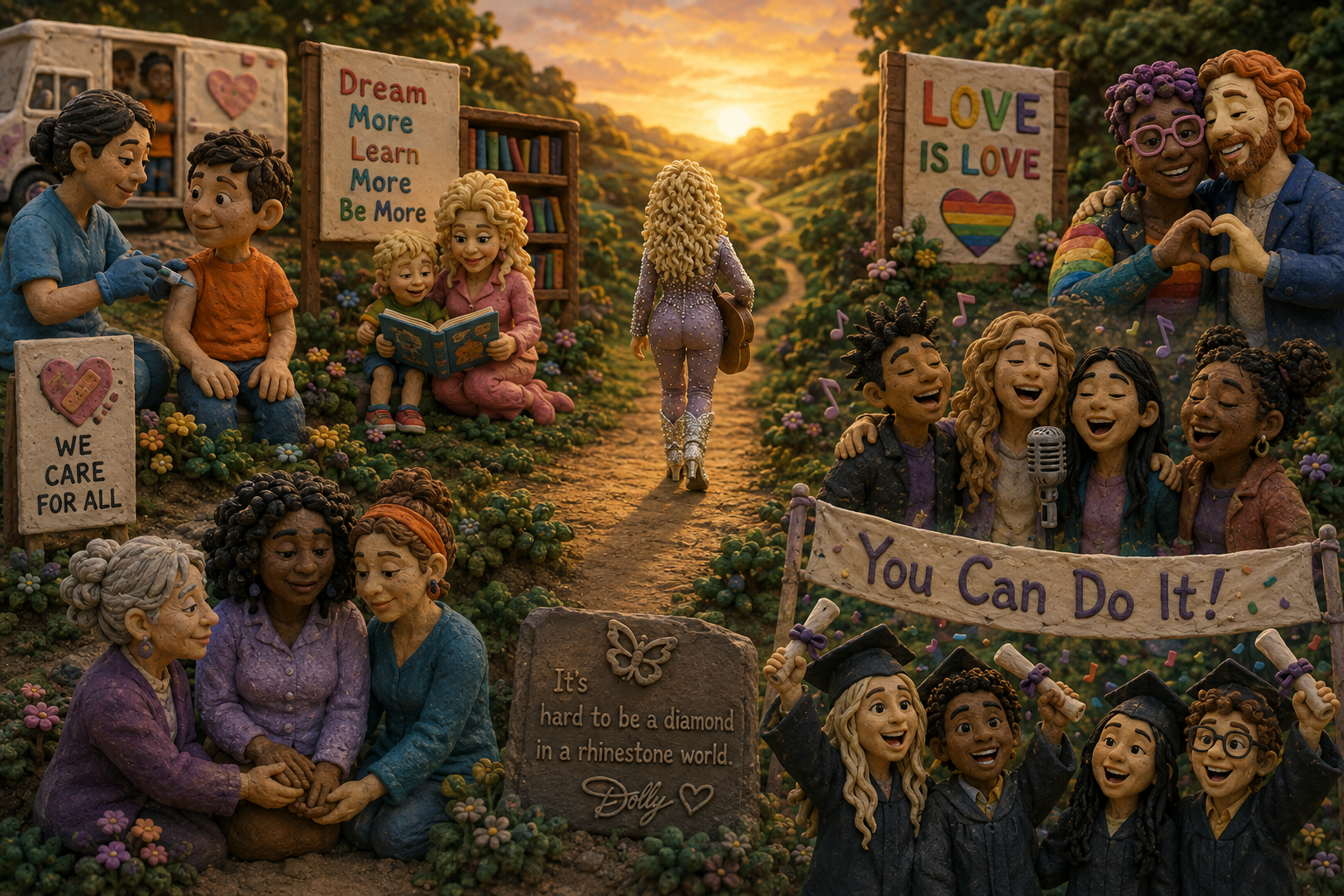
We woke up this morning in a world without Dolly Parton in it.
That is such a strange thing to say. Most of us never met her. We didn’t actually know her. We knew the woman she chose to show us: the enormous hair, the rhinestones, the jokes, the music, the extraordinary talent for drawing every eye in the room. Dolly knew how to market the heck out of Dolly Parton. She had money and connections and, eventually, the ability to do things on a scale most of us could never imagine. And because she was so visible, we got to watch what she chose to do with all of it.
There were other Dolly Partons, of course. There always are. Thousands – probably millions – of people quietly feeding people, putting books into children’s hands, accepting the kid nobody else understands, giving money away, making room, being kind when cruelty would have been easier. We don’t know their names because nobody is pointing a camera at them. Dolly wasn’t remarkable because she invented goodness. She was remarkable because she practised it where the rest of us could see.
I have been thinking that, although she didn’t belong to the Christian denominations that highlight saints, Dolly became something remarkably close to what Christians have traditionally meant by that word. Not a perfect person. Saints never were. Given enough time, history will undoubtedly complicate Dolly Parton. Things will be remembered differently. Things we don’t know may become known. Some choices will look different from a distance. She was human, and eventually history does that to all of our heroes.
But sainthood was never supposed to mean human perfection. Saints are people whose lives point beyond themselves. They show us something about what a human life might look like. And Dolly made choices, over and over again, about what she wanted hers to point toward.
I always laughed when Dolly insisted that she wasn’t political. She may have been one of the most political non-political people in America. She didn’t spend much time telling people how to vote, but she repeatedly demonstrated what she thought people were worth. She showed us what generosity could look like. She put books into the hands of children. She made room for people others wanted pushed aside. She managed, somehow, to communicate acceptance across boundaries that the rest of the world seems determined to turn into battle lines. She showed us how profoundly political ordinary kindness can become.
Perhaps that is why some of the reactions to her death are so fascinating. I have seen people who don’t believe in God, don’t believe in heaven, and certainly don’t believe that Jesus is waiting for us after death nevertheless make an exception for Dolly. If anybody is with Jesus, surely she is. There is something rather wonderful about that. Somewhere along the way, this outrageously made-up, rhinestone-covered country singer became part of our cultural vocabulary for goodness.
And now she isn’t here.
Christians have an odd story about absence. At the Ascension, Jesus leaves. His followers would surely have preferred that he stay, but the story cannot remain centred on one person walking around doing the work while everyone else watches. Eventually the people who have seen the way have to become the people who live the way. I don’t want to draw that parallel too closely – Dolly was Dolly, and Jesus is Jesus – but perhaps there is something here worth noticing.
A world without Dolly Parton should not simply be a world that misses Dolly Parton. If what we admired was real, then her absence asks something of us. The books still need to be put into children’s hands. The outsider still needs someone to make room. Money still needs to be loosened from the hands of those who have enough. People still need to be treated as though their lives matter. Kindness still needs to become something more substantial than a nice idea.
Dolly showed us one way it could be done.
Now, I suppose, it is our turn.
 The Barefoot Evangelist
Leave a comment