Have you ever wondered…
Why won’t my friend talk to me anymore?
Why did my friend choose someone else over me?
Can friends disagree and still be friends?
What makes someone a good friend?
Can trust be rebuilt after someone lets you down?Should you forgive a friend who hurt you?
Can one mistake ruin a friendship?
How do you know if someone is a real friend?
Do friends always have to agree?
Can friends become family?
Is it okay to have more than one best friend?
Should friends always be loyal to each other?
Can people change after they make a mistake?
How many chances should someone get?
What do you do when you feel left out?
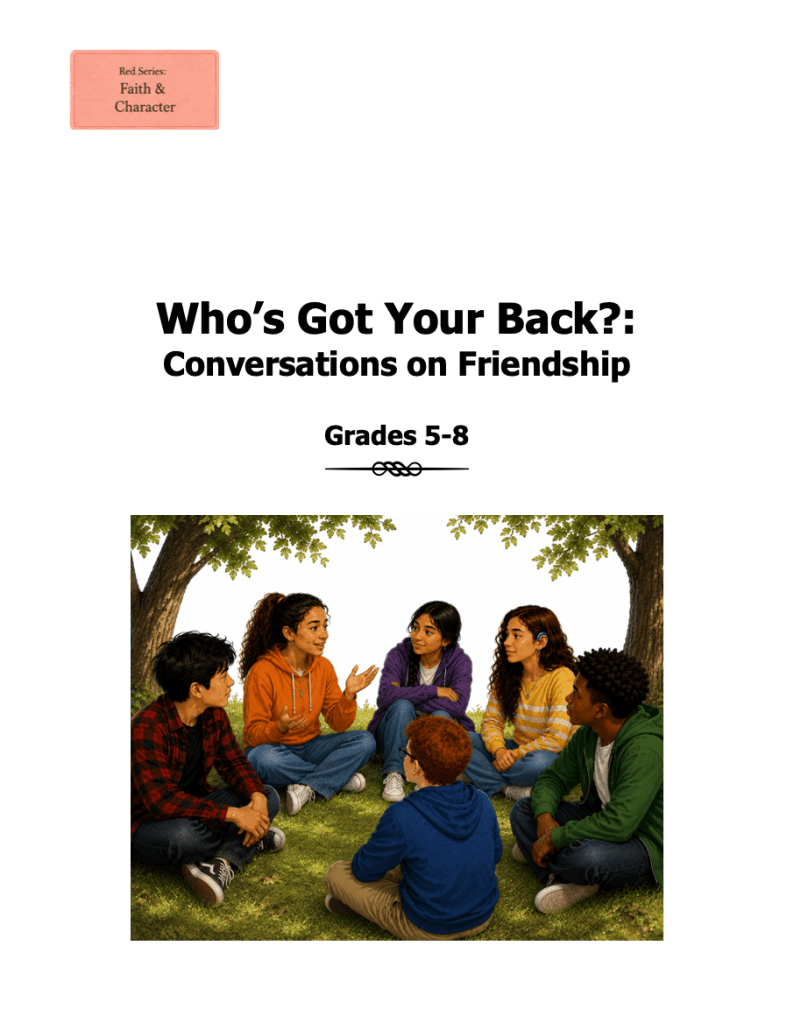
If you’ve ever asked questions like these, you’re not alone. Friendships can be joyful, confusing, exciting, and painful—sometimes all at the same time. Through stories from Scripture, thoughtful conversations, and real-life situations, this workbook invites young people to explore what loyalty, trust, forgiveness, and healthy friendships actually look like.
In this workbook you will discover:
Explore four stories from Scripture that ask difficult questions about friendship, loyalty, trust, forgiveness, and second chances. Through debates, reflections, and critical-thinking activities, students will wrestle with questions that rarely have simple answers. Along the way, they will learn that good people can disagree, friendships can change, and understanding another person’s perspective matters.
What is inside?
- Real-life friendship scenarios and discussion starters
- Four biblical conversations: David and Jonathan, Ruth and Naomi, Jesus and Peter, and Paul and Barnabas
- Debates about loyalty, trust, forgiveness, and independence
- Reflection questions and writing prompts
- Activities that explore different points of view
- Critical-thinking lessons on false dilemmas and hasty generalizations
- Conversations about second chances, boundaries, and disagreement
- Opportunities to explain, defend, and rethink your own ideas
Who is the workbook for?
- Middle-school students in Grades 5–8
- Homeschool families
- Christian schools and classrooms
- Youth groups and confirmation classes
- Parents who want meaningful conversations with their children
- Teachers exploring character, ethics, and relationships
- Anyone who wants to think more deeply about friendship and trust
Why should this matter to me?
Friendships shape who we become. Learning how to handle conflict, rebuild trust, forgive mistakes, and listen to different perspectives are skills that matter far beyond middle school. This workbook does not tell students what to think; instead, it encourages them to ask better questions, consider different viewpoints, and treat others with honesty, loyalty, and compassion.
Where can I buy this?
Related Resources:
Frequently asked Questions:
What age is this workbook for?
The recommended age range appears on the cover. Use it as a guide rather than a rule.
Is this a printable PDF?
Yes. You’ll receive a digital PDF to print at home or in the classroom.
Can I use this in Sunday School?
Yes. These workbooks work well for individual lessons or longer teaching series.
Can I use this for homeschooling?
Absolutely. They were designed with homeschool families in mind.
Can I use this in my classroom?
Yes. They’re suitable for Christian schools and, where appropriate, for studying the Bible as history or literature.
Do I need a Bible?
Helpful, but not always. Scripture references are included where appropriate.
Are the answers included?
Yes, where an activity has a specific correct answer.
Can I print more than one copy?
Please see the licence included with your purchase.
Do I have to be Christian to use these workbooks?
No. They’re also suitable for people exploring the Bible as history, literature, or culture.
Are these tied to one denomination?
No. They draw on the shared Christian tradition while encouraging curiosity and thoughtful learning.

