
God surprises us by doing things we don’t expect and inverting the status quo
John 13 It was before Passover, and Jesus knew that the time had come for him to leave this world and to return to the Father. He had always loved his followers in this world, and he loved them to the very end.
2 Even before the evening meal started, the devil had made Judas, the son of Simon Iscariot, decide to betray Jesus.
3 Jesus knew he had come from God and would go back to God. He also knew that the Father had given him complete power. 4 So during the meal Jesus got up, removed his outer garment, and wrapped a towel around his waist. 5 He put some water into a large bowl. Then he began washing his disciples’ feet and drying them with the towel he was wearing.
6 But when he came to Simon Peter, this disciple asked, “Lord, are you going to wash my feet?”
7 Jesus answered, “You don’t really know what I am doing, but later you will understand.”
8 “You will never wash my feet!” Peter replied.
“If I don’t wash you,” Jesus told him, “you don’t really belong to me.”
9 Peter said, “Lord, don’t wash just my feet. Wash my hands and my head.”
10 Jesus answered, “People who have bathed and are clean all over need to wash just their feet. And you, my disciples, are clean, except for one of you.” 11 Jesus knew who would betray him. That is why he said, “except for one of you.”
12 After Jesus had washed his disciples’ feet and had put his outer garment back on, he sat down again. Then he said:
Do you understand what I have done? 13 You call me your teacher and Lord, and you should, because that is who I am. 14 And if your Lord and teacher has washed your feet, you should do the same for each other. 15 I have set the example, and you should do for each other exactly what I have done for you. 16 I tell you for certain that servants are not greater than their master, and messengers are not greater than the one who sent them. 17 You know these things, and God will bless you, if you do them.
Prayers
from the leonine sacramentary (c. 550 CE)
O Lord our God, refresh us with quiet sleep, when we are wearied with the day’s labour; that being assisted with the help which our weakness needs, we may be devoted to thee both in body and mind; through Jesus Christ our Lord.
Be present, O Lord, to our prayers, and protect us by day and night; that in all successive changes of times we may ever be strengthened by thine unchangeableness; through Jesus Christ our Lord. Amen.
Egeria in the Holy land, c. 380 CE
Egeria was a nun from France who was touring the Holy Land in the late 4th century. She was in Jerusalem during Holy Week and provides the only eye witness account of how the early church celebrated.
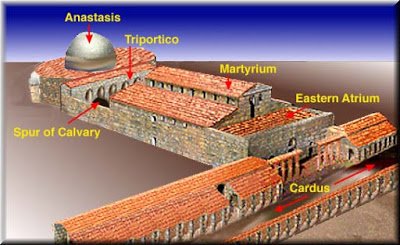
On Thursday whatever is customarily done from the first cockcrow until morning and what is done at the third and sixth hours takes place as the Anastasis. At the eighth hour all the people gather as usual at the Martyrium, earlier, however, than on other days, because the dismissal must be given more quickly. When all the people have assembled, the prescribed rites are celebrated. On that day the sacrifice is offered at the Martyrium, and the dismissal from there is given around the tenth hour. Before the dismissal is given, however, the archdeacon raises his voice, saying: “At the first hour of the night let us assemble at the church which is on the Eleona, for much toil lies ahead of us on this day’s night.” Following the dismissal from the Martyrium, everyone proceeds behind the Cross, where, after a hymn is sung and a prayer is said, the bishop offers the sacrifice and everyone receives Communion. Except on this one day, throughout the year the sacrifice is never offered behind the Cross save on this day alone… everyone goes to the Eleona, to the church where the grotto is which the Lord gathered with His disciples on that day is located. And there until around the fifth hour of the night, they continually sing hymns and antiphons and read the scriptural passages proper to the place and to the day. Between these, prayers are said. Moreover, they read those passages from the Gospels in which the Lord spoke to His disciples on that day while sitting in the same grotto which lies within this church. And from here, around the sixth hour of the night, everyone goes up to the Imbomon, singing hymns. That is the place from which the Lord ascended into heaven. There also they sing hymns and antiphons and read scriptural passages proper to the day; and whatever prayers are said, whatever prayers the bishop recites, they will always be proper to the day and to the place.
As soon as it begins to be the hour of the cockcrow, everyone comes down from the Imbomon singing hymns and proceeds towards the very place where the Lord prayed, as it is written in the Gospel: “And He went as far as a stone’s throw and He prayed”, and so forth. On that spot stands a tasteful church… Next, everyone, including the smallest children, walk down from there to Gethsemani, accompanying the bishop with hymns. Singing hymns, they come to Gethsemani very slowly on account of the great multitude of people, who are fatigued by vigils and exhausted by the daily fasts… On arriving in Gethsemani a suitable prayer is first said, followed by a hymn, and then the passage from the Gospel describing the arrest of the Lord is read. During the reading of this passage there is such moaning and groaning with weeping from all the people that their moaning can be heard practically as far as the city… From there, throughout the center of the city, all without exception are ready at hand, the old and the young, the rich and the poor, everyone: and on this day especially no none withdraws from the vigil before early morning… When they finally arrive before the Cross, it is already beginning to be broad daylight. There then is read the passage from the Gospel where the Lord is led before Pilate, and whatsoever words are written that Pilate spoke to the Lord or to the Jews, all this is read.
 The Barefoot Evangelist
Leave a comment