
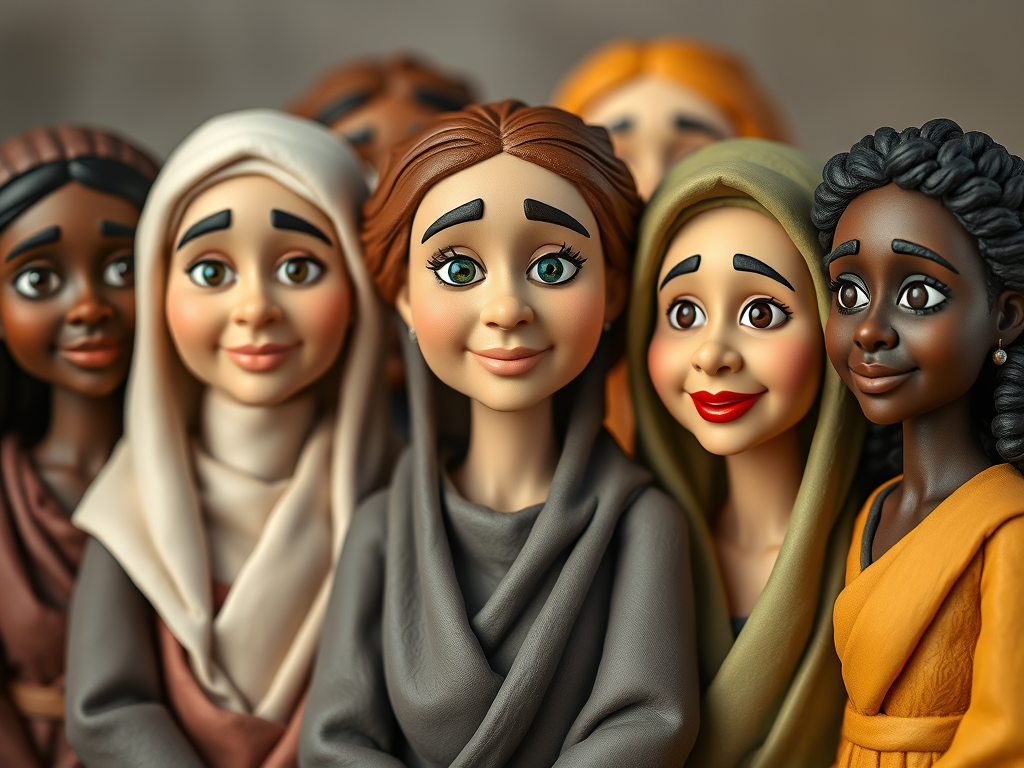
One of my endless frustrations with conservative minded preachers and writers in all Christian denominations, is their almost pathological need to erase or reduce the women of the Bible. Their self-defence of “keeping within the Biblical narrative” suddenly disappears with this form of misogyny.
When I was in Germany several years ago, I was at a banquet seated beside a man who was trained in the fourth order of a monastic group (fourth meant they followed the order for social action and prayer, but not for living situation or marital status). He honestly, without a hint of irony or insult, responded to my academic work by saying there weren’t a lot of women in the Bible.
Those comments don’t go well with me, and so I proceeded to list several of them. It wasn’t long before he put up his hands in surrender and said he was sorry, he had no idea. We had a great conversation about Biblical women after that.
Too many women have turned away from the Bible with the same assumption, that it’s a book about God and men…. not used as a generic term… and they won’t find themselves in it. I have had many conversations correcting that assumption as well.
One of the places few realize women are listed is in Matthew’s opening chapter in the Chronology of Jesus. The writer of the Gospel of Matthew put four women on that list, something that traditionally only included men, underscoring their importance to the narrative of Jesus being in the lines of both David and Abraham. Each of those women had to push back against the patriarchal assumptions of the day and demand their equality and that of their children, and the results were always agreements with those women.
The first was Tamar. There are two Tamar’s in the Bible, but the first one was a mother in the line leading to King David. When she lost both husbands and was denied a third based on the legal assumptions of the day (Genesis 38), she set about managing her situation in her own way and making her father-in-law publicly acknowledge that he had wronged her and was the father of her children. (Read about Levirate Marriage laws to better understand the issues.)
The second was Rahab, who might be the woman in Joshua 2, who protected the Israelites from the leaders of Jericho, but is more likely an entirely different Rahab, given timelines. If she were the second Rahab, we have no Biblical reference to her importance, but the writer of Matthew felt she deserved to be remembered in his chronology.
The third was Ruth. With an entire book dedicated to her and her story well known by many, she is a harder woman to erase. Politically and historically, the story of Ruth, written when the wealthy and learneds of Judah were returning from exile in Babylon and wanted a ‘purified’ Hebrew nation, positioned her – a foreigner – as the great-grandmother of King David. This underscored the ridiculousness of ridding all foreigners, and how God’s plan involved everyone, not just those with pure Hebrew lineage. (For more on this ‘cleansing’, look to the end of Ezra.)
The final woman mentioned was Bathsheba (II Samual 11-12, I Kings 1-2), who unfortunately isn’t given the dignity of her own name but referenced only as the “wife of Uriah”. After losing her infant eldest son, who was conceived in a less-than-honourable way with King David, her second son Solomon became known as the wisest king in Hebrew history. Bathsheba was not passive in her son becoming king, and after her advocacy and machinations to ensure an aging David kept his promise to Solomon, she became the powerful queen mother of the Hebrew people.
Women throughout the Bible were smart, inventive, strategic, articulate, loyal, questioned authority, were faithful to God, and did not sit back when their situation seemed impossible. We need to remember those women and their stories today, and not erase them for some male myth of singular importance within the Biblical narrative.
 The Barefoot Evangelist
Leave a comment