Human beings have a funny habit. We often mistake what is familiar for what is neutral.
Take clothing. In much of the Western world, “men’s clothes” and “women’s clothes” are easy to identify. But “gender neutral” clothing often turns out to mean jeans, T-shirts, and sneakers. Rarely do we imagine dresses, bright colours, or flowing fabrics when we speak of neutral fashion. Somehow, we unconsciously assume that masculine styles are universal while feminine styles remain special categories.
Our language about God sometimes works the same way.
For centuries, Christians have spoken almost exclusively of God as Father, King, and Lord. Today, some people seek more inclusive language and prefer names such as Creator, Holy One, or Loving Parent. There is nothing wrong with these names. But if we move directly from masculine imagery to gender-neutral language, we risk carrying our assumptions with us. “Neutral” can easily become “male without admitting it.”
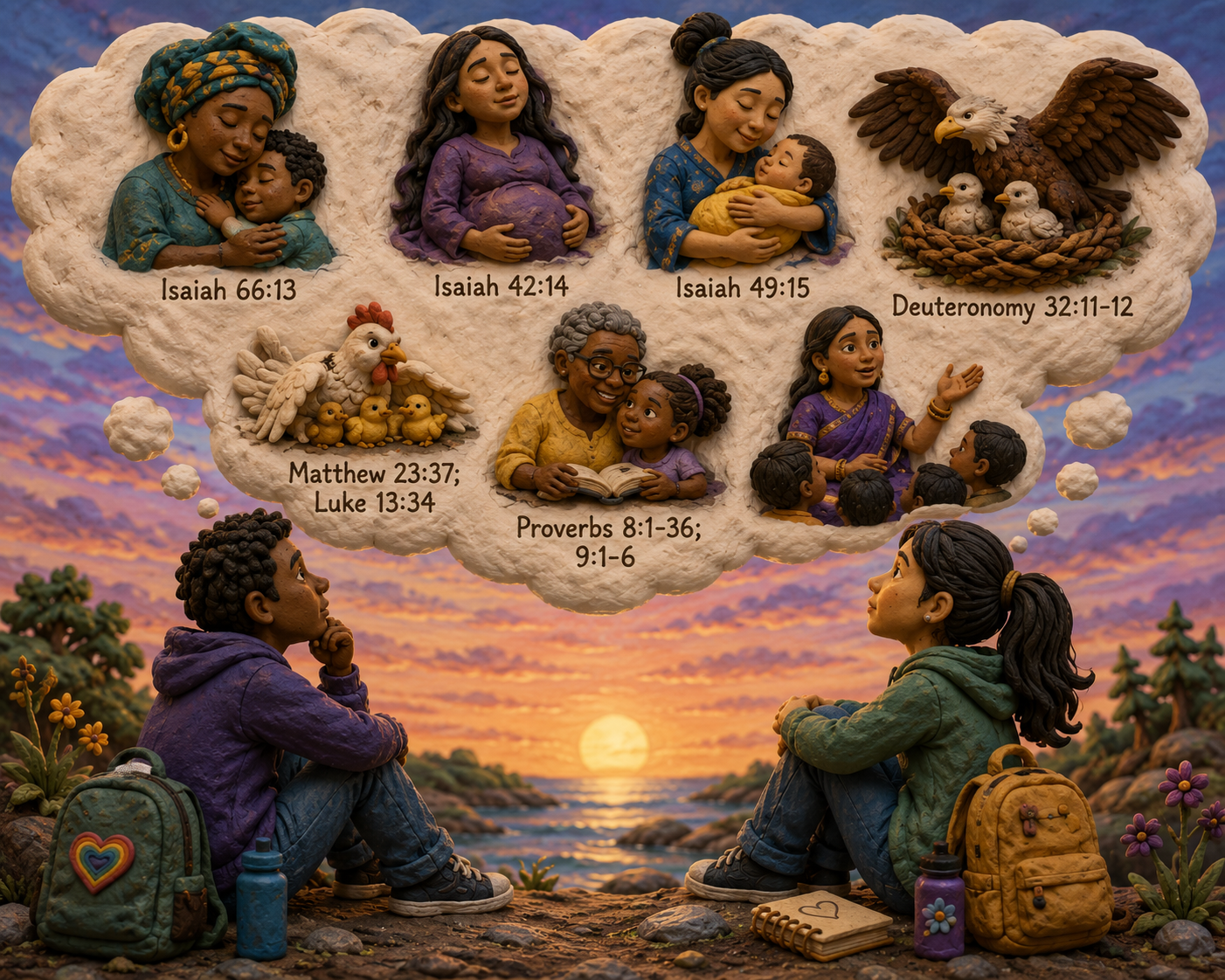
Scripture itself offers another path. Alongside the language of Father and King, we find God compared to a mother comforting her child (Isaiah 66:13), a woman in labour crying out and bringing forth life (Isaiah 42:14), a mother who cannot forget the child at her breast (Isaiah 49:15), a mother eagle hovering over and carrying her young (Deuteronomy 32:11-12), and a mother hen sheltering her chicks beneath her wings (Matthew 23:37; Luke 13:34). Divine Wisdom herself is portrayed as a woman calling humanity to a better way (Proverbs 8:1-36; 9:1-6). These images are not modern inventions. They have always been part of our tradition, even if they have often been overlooked.
Perhaps before we rush to gender-neutral language, we need to spend some time recovering these forgotten images. Not because God is female any more than God is male, but because the feminine has been underrepresented in our speech and imagination. We cannot transcend what we have not first embraced.
The goal is not to replace Father with Mother, nor to abandon the language that has nourished generations of Christians. The goal is something deeper. It is to remember that both women and men bear the image of God (Genesis 1:27) and that the divine mystery is larger than either. Father and Mother, Wisdom and Shepherd, Creator and Holy One – each offers a window into the One who cannot be contained by any single metaphor.
Perhaps true inclusivity does not begin by erasing difference. Perhaps it begins by honouring what has been forgotten. Only then can we move beyond the limits of our categories and discover that God has always been larger than the words we use.


Leave a Reply