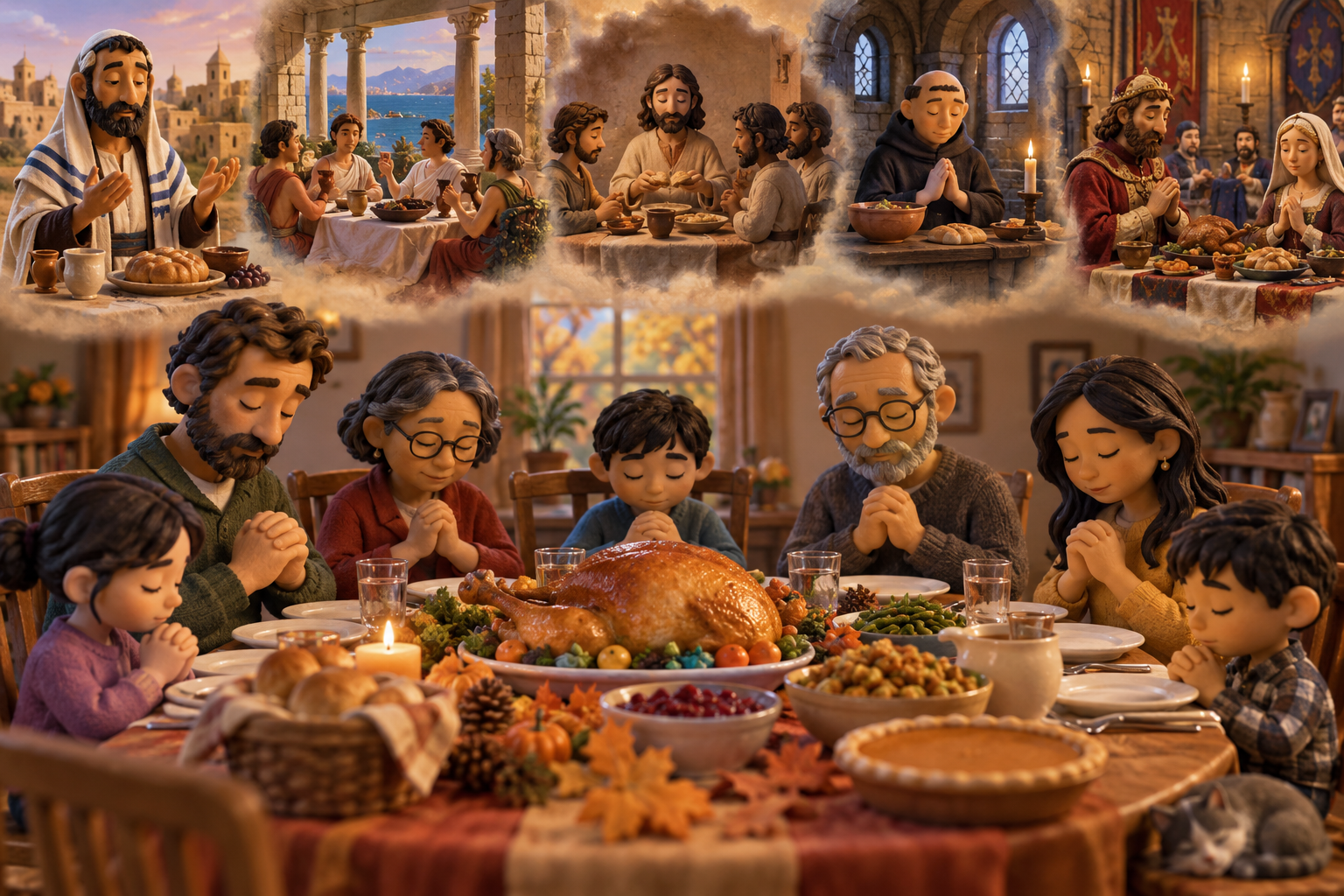
Thanksgiving is coming, which means that sometime in the next few weeks, people all over Canada will gather around tables loaded with turkey, potatoes, stuffing, vegetables, pies and all the other foods that somehow became essential to the occasion. And then, just as everyone is ready to eat, somebody will say, “Wait – we need to say grace.” Heads will bow, hands may be held, and someone will thank God for the food. In some families it will be a familiar prayer. In others, some poor unsuspecting person will be volunteered on the spot. But have you ever wondered why we do it? Why do Christians “bless the food” before we eat?
The answer begins before Christianity. Jesus grew up in a Hebrew world in which blessing and eating belonged together. But there is an important difference between the ancient practice and the way Christians often talk about it today. A Jewish berakhah, or blessing, blesses God. “Blessed are you, Lord our God…” The bread isn’t being blessed. God is being praised as the one who brings bread from the earth. And the biblical command in Deuteronomy is actually to offer that blessing after eating: “You shall eat and be satisfied, and bless the Lord your God.” Later Jewish practice developed blessings both before and after eating. The meal became bracketed by remembering where the food ultimately came from.
Meals in the ancient Mediterranean world also meant far more than getting enough calories to make it through the day. Eating together told people who belonged, who had status, who was host and who was guest. Where you ate and with whom mattered. That helps explain why meals appear so often in the Gospels – and why Paul gets so angry with the Corinthians when their communal meal reproduces the inequalities of the world around them. Some are eating well while others go hungry. For Paul, you cannot proclaim yourselves one body at the table while behaving as though some bodies matter more than others.
The earliest Christians carried that connection between food, thanksgiving and community into their own gatherings. The Didache, one of our earliest Christian documents outside the New Testament, contains prayers of thanksgiving over the cup and the broken bread, followed by another prayer after everyone has eaten. These weren’t yet neatly divided into the categories we recognize as “Communion” and “supper.” Early Christian meals could be both real meals and ritual meals. Christians gathered, ate, prayed, gave thanks and told the story of who they were together. Over the next few centuries those practices changed, and the Eucharist gradually became a more formal and distinct act of Christian worship.
But prayer didn’t disappear from the ordinary table when Eucharist moved into a more formal worship setting. Christians continued praying when they ate. Monastic communities built prayer and Scripture into the rhythm of communal meals. Christian households taught children to pray at the table. Different cultures and denominations developed their own forms: memorized graces, spontaneous prayers, sung prayers, elaborate blessings and the very brief “Thank you, God, for this food” offered while everyone hopes the gravy isn’t getting cold.
Somewhere along the way, many of us began calling this “blessing the food.” That is an interesting shift. Listen to many modern Christian graces and you’ll hear some version of, “Bless this food to our bodies.” There is nothing particularly wrong with asking God to bless what we eat. But it can obscure the older idea. Our ancestors weren’t primarily asking God to do something to the dinner. They were doing something themselves: stopping long enough to acknowledge the source of what was in front of them.
And that makes grace about considerably more than good manners before Thanksgiving dinner. A table tells a story. Who grew this food? Who harvested it? Who could afford to buy it? Who prepared it? Who is sitting here, and who has been left out? Who gets plenty while someone else goes hungry? Those aren’t new questions. Christians were struggling with them around their tables two thousand years ago. Saying grace does not magically answer them, but it can interrupt us long enough to notice that eating has never been an entirely private act.
So perhaps this Thanksgiving, when someone says, “Wait – we haven’t said grace,” we might hear those words a little differently. We aren’t performing the Christian equivalent of saying please and thank you before we’re allowed to eat the pie. We are joining an ancient practice of stopping at the table and remembering: this food did not begin with us. We depend upon the earth, upon other human beings, and ultimately upon God. And perhaps the oldest question hiding inside grace is not simply, “Have we thanked God for our food?” but “What kind of people will we be because we have been fed?”


Leave a Reply