God surprises us by doing things we don’t expect and inverting the status quo
John 19 12 Then Pilate wanted to set Jesus free. But the crowd again yelled, “If you set this man free, you are no friend of the Emperor! Anyone who claims to be a king is an enemy of the Emperor.”
13 When Pilate heard this, he brought Jesus out. Then he sat down on the judge’s bench at the place known as “The Stone Pavement.” In Aramaic this pavement is called “Gabbatha.” 14 It was about noon on the day before Passover, and Pilate said to the crowd, “Look at your king!”
15 “Kill him! Kill him!” they yelled. “Nail him to a cross!”
“So you want me to nail your king to a cross?” Pilate asked.
The chief priests replied, “The Emperor is our king!” 16 Then Pilate handed Jesus over to be nailed to a cross.
Jesus was taken away, 17 and he carried his cross to a place known as “The Skull.” In Aramaic this place is called “Golgotha.” 18 There Jesus was nailed to the cross, and on each side of him a man was also nailed to a cross.
19 Pilate ordered the charge against Jesus to be written on a board and put above the cross. It read, “Jesus of Nazareth, King of the Jews.” 20 The words were written in Hebrew, Latin, and Greek.
The place where Jesus was taken wasn’t far from the city, and many of the people read the charge against him. 21 So the chief priests went to Pilate and said, “Why did you write that he is King of the Jews? You should have written, ‘He claimed to be King of the Jews.’ ”
22 But Pilate told them, “What is written will not be changed!”
Prayers
from margaret of antioch 289-304 CE)
O Lord God, Ruler of heaven and of the earth, Creator of things visible and invisible, Giver of eternal life and Consoler of the sorrowful, make me to stand firm in the confession of they name that as with thine aid I have begun the good fight, so with thine aid I may be deemed worthy to gain the victory, lest the adversary spitefully mock at me saying: “Where is now her God in whom she trusted?”… Amen.
Egeria in the Holy land, c. 380 CE
Egeria was a nun from France who was touring the Holy Land in the late 4th century. She was in Jerusalem during Holy Week and provides the only eye witness account of how the early church celebrated.
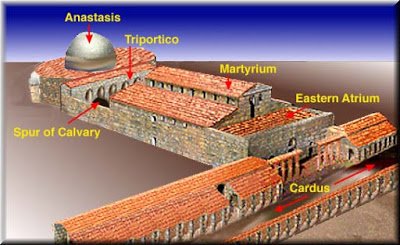
… following the dismissal from the Cross which occurs before sunrise, everyone now stirred up goes immediately to Sion to pray at the pillar where the Lord was whipped. Returning from there then, everyone rests for a short time in his own house, and soon all are ready. A throne is set up for the bishop on Golgotha behind the Cross, which now stands there. The bishop sits on his throne, a table covered with a linen cloth is set before him, and the deacons stand around the table. The gilded silver casket containing the sacred wood of the cross is brought in and opened. Both the wood of the cross and the inscription are taken and placed on the table. As soon as they have been placed on the table, the bishop, remaining seated, grips the ends of the sacred wood with his hands, while the deacons, who are standing about, keep watch over it. There is a reason why it is guarded in this manner. It is the practice here for all the people to come forth one by one, the faithful as well as the catechumens, to bow down before the table, kiss the holy wood, and then move on. It is said that someone (I do not know when) took a bite and stole a piece of the holy cross. Therefore it is now guarded by the deacons standing around, lest there be anyone who dare come do that again… All the people pass through one by one; all of them bow down, touching the cross and the inscription, first with their foreheads, then with their eyes; and after kissing the cross they move on. No one, however, puts out his hand to touch the cross… When the sixth hour is at hand, everyone goes before the Cross, regardless of whether it is raining or whether it is hot. This place has no roof, for it is a sort of very large and beautiful courtyard lying between the Cross and the Anastasis. The people are so clustered together there that it is impossible for anything to be opened. A chair is placed for the bishop before the Cross, and from the sixth to the ninth hours nothing else is done except the reading of the passages from Scripture… There is no one young or old, who on this day does not sob more than can be imagined for the whole three hours, because the Lord suffered all this for us. After this, when the ninth hours is at hand, the passage is read from the Gospel according to Saint John where Christ gave up His spirit. After this reading, a prayer is said and the dismissal is given… After the dismissal from the Martyrium, everyone comes to the Anastasis, and after they have arrived there, the passage from the Gospel is read where Joseph seeks from Pilate the body of the Lord and places it in a new tomb… And so, those among the people who wish, or rather those who are able, to keep the vigil do so until dawn… The greater part of the people keep watch, some from evening on, others from midnight, each one doing what he can.
 The Barefoot Evangelist
Leave a comment