Have you ever wondered…
What do the numbers 7, 12, and 40 mean in the Bible?
What is a cubit in the Bible?
How long is a cubit?
What is a shekel in the Bible?
What is a tithe in the Bible?
What are biblical weights and measures?
Why did Jesus say seventy times seven?
How did people count in Bible times?
How did people measure things in the Bible?
What calendar did Jesus use?
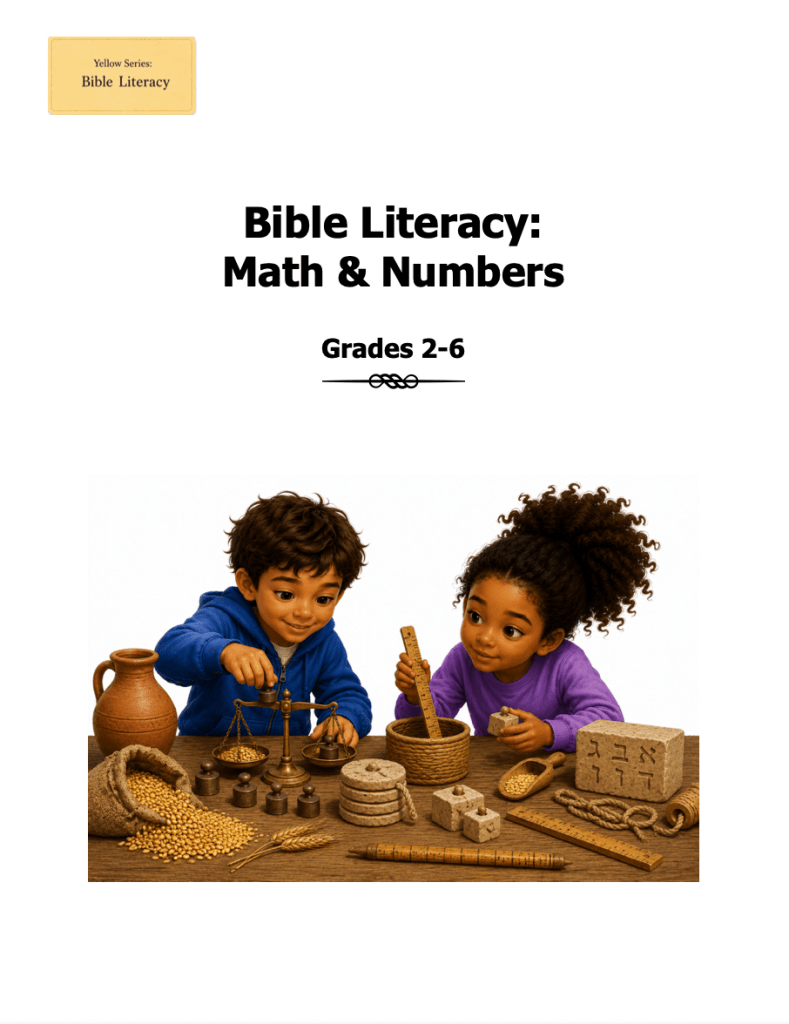
If you’ve ever wondered about these questions, you’re in the right place. Through games, maps, puzzles, timelines, and hands-on activities, this workbook introduces children to the world of numbers in the Bible. Students will explore measurements, money, calendars, travel, and the stories behind some of Scripture’s most famous numbers.
In this workbook you will discover:
Discover how people in Bible times counted, measured, travelled, traded, and organized their lives long before calculators, rulers, and clocks. Through engaging activities, children will learn about cubits, shekels, tithes, ancient calendars, and the meanings attached to numbers like 7, 12, and 40. They will discover that mathematics in the ancient world was about much more than addition and subtraction.
What is inside?
- How Hebrew, Greek, and Roman people wrote numbers
- Why zero did not exist in biblical times
- Cubits, spans, and handbreadths
- Ancient weights and measurements
- How far people travelled on foot
- Money, shekels, denarii, and talents
- Tithes and how they were calculated
- Jewish and Roman calendars
- How ancient people counted days
- Special numbers like 3, 7, 12, 40, 70 × 7, and 666
Who is the workbook for?
- Homeschool families
- Sunday SchoolChristian schools
- Bible literacy units
- Confirmation and discipleship classes
- Family devotions
- Classrooms exploring religion, history, or mathematics
Why should this matter to me?
Learning about math in the Bible is about more than memorizing numbers. Ancient people used mathematics to measure grain, build houses, travel long distances, keep calendars, celebrate festivals, and tell stories. When children understand how people counted and measured in the ancient world, they gain a deeper appreciation for Scripture and discover that mathematics is part of everyday life. Bible literacy helps children connect history, faith, and the world around them.
Where can I buy this?
Related Resources:
Frequently asked Questions:
What age is this workbook for?
The recommended age range appears on the cover. Use it as a guide rather than a rule.
Is this a printable PDF?
Yes. You’ll receive a digital PDF to print at home or in the classroom.
Can I use this in Sunday School?
Yes. These workbooks work well for individual lessons or longer teaching series.
Can I use this for homeschooling?
Absolutely. They were designed with homeschool families in mind.
Can I use this in my classroom?
Yes. They’re suitable for Christian schools and, where appropriate, for studying the Bible as history or literature.
Do I need a Bible?
Helpful, but not always. Scripture references are included where appropriate.
Are the answers included?
Yes, where an activity has a specific correct answer.
Can I print more than one copy?
Please see the licence included with your purchase.
Do I have to be Christian to use these workbooks?
No. They’re also suitable for people exploring the Bible as history, literature, or culture.
Are these tied to one denomination?
No. They draw on the shared Christian tradition while encouraging curiosity and thoughtful learning.

