Have you ever wondered…
Why are there four Gospels instead of one?
Why are Matthew, Mark, Luke, and John different from each other?
Why do Matthew, Mark, and Luke look so similar?
Why is John’s Gospel so different?
Which Gospel was written first?
Why are there only four Gospels in the Bible?
Why weren’t other gospels included?
Who wrote the four Gospels?
Did the Gospel writers copy each other?
What audience was each Gospel written for?
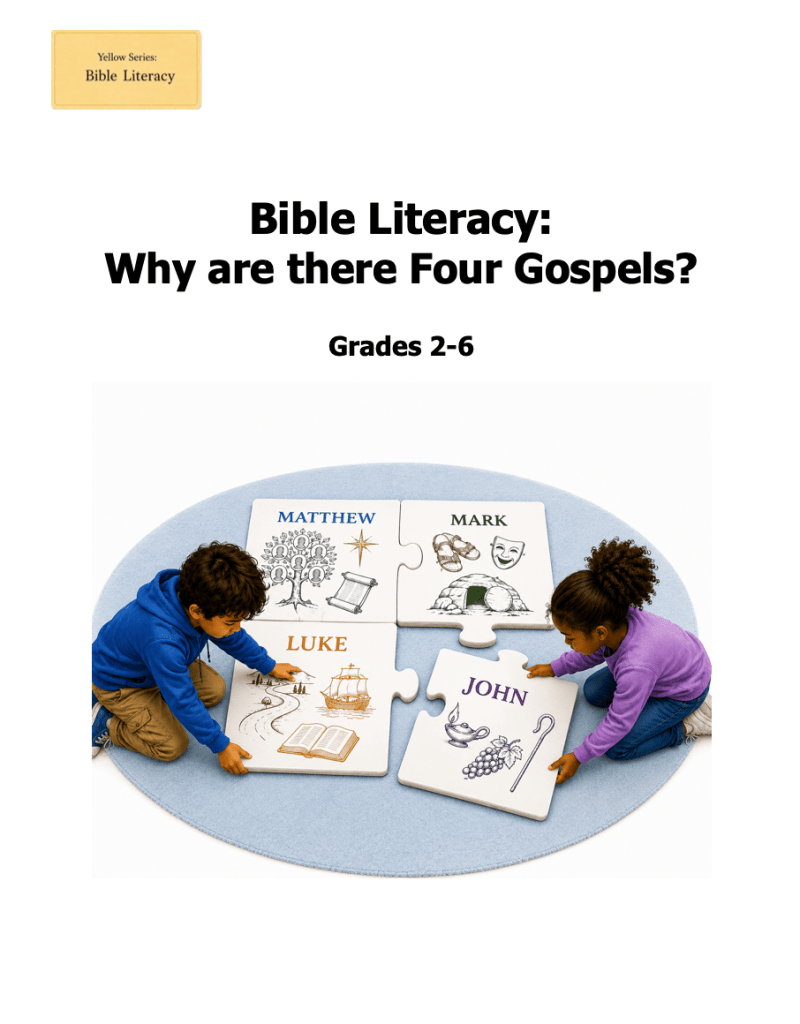
If you’ve ever wondered why Christians have four different Gospels instead of one, you’re in the right place. Through timelines, maps, puzzles, and hands-on activities, this workbook invites children to become Bible detectives as they explore Matthew, Mark, Luke, and John and discover why each Gospel tells the story of Jesus in a unique way.
In this workbook you will discover:
Discover why the Bible contains four different Gospels instead of just one. Through timelines, maps, puzzles, and hands-on activities, children will explore who Matthew, Mark, Luke, and John might have been, when and where the Gospels were written, and why each writer told the story of Jesus in a different way. Students will compare stories, think like historians and detectives, and discover how early Christians understood Jesus and shared his story with the world.
What is inside?
- timelines comparing Roman and Christian history;
- maps showing where scholars think the Gospels may have been written;
- word searches and Bible detective activities;
- Gospel comparison charts;
- source theory diagrams;
- Bible exploration exercises;
- discussion questions for families and classrooms.
Who is the workbook for?
- homeschool families
- Sunday schools
- church libraries
- Christian classrooms
- Bible clubs
- families who enjoy exploring Scripture together.
Why should this matter to me?
The four Gospels are more than four versions of the same story. They were written by different communities, in different places, and for different reasons. When children learn to compare stories, ask questions, and notice different perspectives, they gain the confidence to explore the Bible for themselves and discover that faith and curiosity belong together.
Where can I buy this?
Related Resources:

Frequently asked Questions:
What age is this workbook for?
The recommended age range appears on the cover. Use it as a guide rather than a rule.
Is this a printable PDF?
Yes. You’ll receive a digital PDF to print at home or in the classroom.
Can I use this in Sunday School?
Yes. These workbooks work well for individual lessons or longer teaching series.
Can I use this for homeschooling?
Absolutely. They were designed with homeschool families in mind.
Can I use this in my classroom?
Yes. They’re suitable for Christian schools and, where appropriate, for studying the Bible as history or literature.
Do I need a Bible?
Helpful, but not always. Scripture references are included where appropriate.
Are the answers included?
Yes, where an activity has a specific correct answer.
Can I print more than one copy?
Please see the licence included with your purchase.
Do I have to be Christian to use these workbooks?
No. They’re also suitable for people exploring the Bible as history, literature, or culture.
Are these tied to one denomination?
No. They draw on the shared Christian tradition while encouraging curiosity and thoughtful learning.

